|
|
 |
 |
Country: |
Italia |
Locality: |
Mompantero - see original record (ask compiler - institution) |
|
|
Region: |
Piemonte |
Area: |
Valsusa |
|
|
|
|
|
|
|
| |
 |
Environment & Surface |
 |
|
|
|
Altitude:
|
1025 m
Open-air
Shelter
Cave
Portable
Megalithic
|
Geography: |
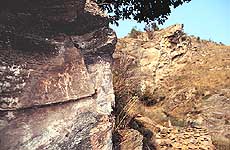
Rocky slope, southward exposed, panoramic site, abandoned sheep pasture, xerophilous vegetation (Juniperus, little pine-tree), stone walls, arid and windy area, lateral morainic pudding-stone deposits. |
Proximity: |
Path, dry waterfall (originating from an abandoned artificial channel). |
|
|
Geology: |
Filladic calcschist (metamorphic rock composed by calcite and mica), vertical wall, calcite and weddellite from the analysis of the painting material. |
Surface: |
Rough, steps, vertical half-sheltered wall south-east exposed, 90° of inclination, encrusted white lichens, patina, calcareous (calcite) encrustation. |
|
Dimensions:
|
Length 0.90 m.
Width 6.00 m.
|
|
|
|
|
|
|
|
| |
|
Art |
|
|
|
Description: |
Engravings
Paintings
Painted engravings
High or low-relief
Sculpture
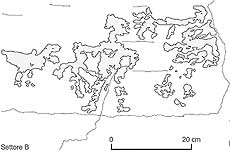
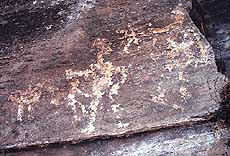
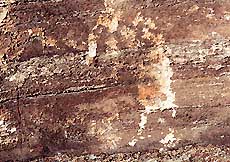
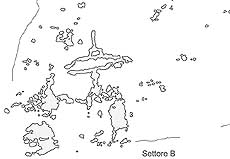
The paintings cover a 6x0.9 m surface along the rocky wall. The sector B is the right part. The painting material is thick and with many concretions of a white-yellow colour. The sector B can be divided into a right part, with two warriors (archers), and a right part, with no war-related figures, but a possible family-life scene (two parents, a baby, hens or ducks)
|
Figures: |
total number 13
2 archers (1 with bi-triangular body), 1 little human figure (a baby?), 1 human figure, 1 human-figure large-fingered, 2 possible ornithomorphic figure, 9 unreadable eroded figures.
|
|
|
Chronology: |
Palaeolithic
Epipalaeolithic - Mesolithic
Neolithic
Copper Age
Bronze Age
Iron Age
Roman
Middle Age
Modern
Unknown
It is possible to compare these painted figures to the warriors with bi-triangular body of Aussois (Haute Maurienne). These warriors overlap Middle Iron Age topographic compositions and are very similar to the figures painted over the decorated italic pottery (VII-VI cent. BC) or the south France pottery (La Pègue, V-IV cent. BC). In this range (VII-IV cent. BC) it is possible to date also the Mompantero paintings.
|
Notes: |
The paintings have been discovered by Angelo Fossati and Andrea Arcà in 1991. The sample for chemical analysis have been taken form figure A10 (horse) and B12 (right arm). Similar composition has been found in the natural calcite deposits. The entire area was terraced and cultivated (vines, potatoes) till the '50-'60s. No water available if not through artificial channels. It's one of the possible ways to reach the top of the Rocciamelone mountain (more than 3500 m), the highest mountain in the Susa valley, where traditional pilgrimage is still practised (the Holy Mary of the Rocciamelone, http://www.rupestre.net/archiv/nat3.htm)). |
|
|
|
|
| |
|
Bibliography |
|
|
|
|
|
| |
|
Conservation |
|
|
|
Status: |
Public
Private
Park
Classified site
|
Risk: |
The site is poorly attended, thus some people is passing with motorbikes along the mountain path. The surface is half-sheltered and protected from direct rain and snow. |
|
|
Conservation: |
Good
Quite good
Mediocre
Bad
|
Intervention: |
The rock has been completely recorded (International western Alps rock art record), traced (contact tracing and digital vectorial rendition), photographed (normal light and grazing light colour slides) under enchargement of the Archaeological Superintendence of Piedmont. More info (Italian version) at http://rupestre.net/archiv and http://rupestre.net/alps. |
|
|
|
|
|
|
By |
|
|
| |
| Record n. 498 / 807 |
No commercial use is allowed. Specific © is mentioned in the captions or owned by each Author or Institution |
|
| |
|
EuroPreArt, European Prehistoric Art, is a web-based archaeological project funded by the European Union which aims to establish a lasting data-base of European prehistoric art documentation, to launch the base of an European institutional network and to contribute to the awareness of the diversity and richness of European Prehistoric Art.
It is proposed by: Instituto Politécnico de Tomar (IPT, Portugal),
CUEBC - European University Centre for Cultural Heritage (Italy - Europe),
Consejo Superior de Investigaciones Científicas (España),
Asociación Cultural Colectivo Barbaón (España),
Université de Liège (Belgique),
Gotland University College (Sverige),
University College Dublin (Eire),
Cooperativa Archeologica Le Orme dell'Uomo (Italia),
Study Centre and Museum of Prehistoric Art of
Pinerolo (Italia),
The European Centre for Prehistoric Research in the Alto Ribatejo (Portugal),
ArqueoJovem - a youth NGO (Portugal).
|
|
|
|
|
|


 NEW: Alpine rock paintings


 Specific feedback
 Total
Total General
 Specific